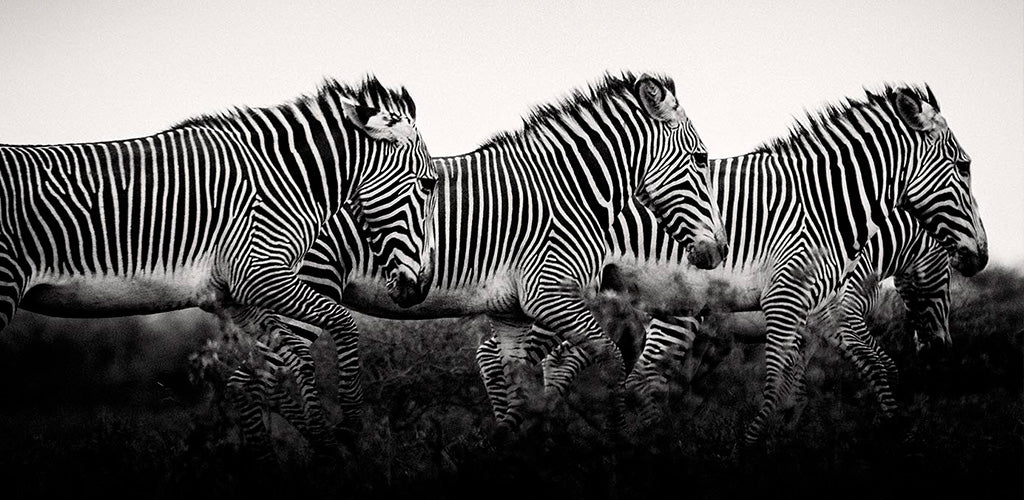
Grevy's zebra in Northern Kenya
Call of the Wild
Mia Collis, the Kenyan lenswoman behind our Zebra Luminescent Eye Shade, shares how she gets her best shots.
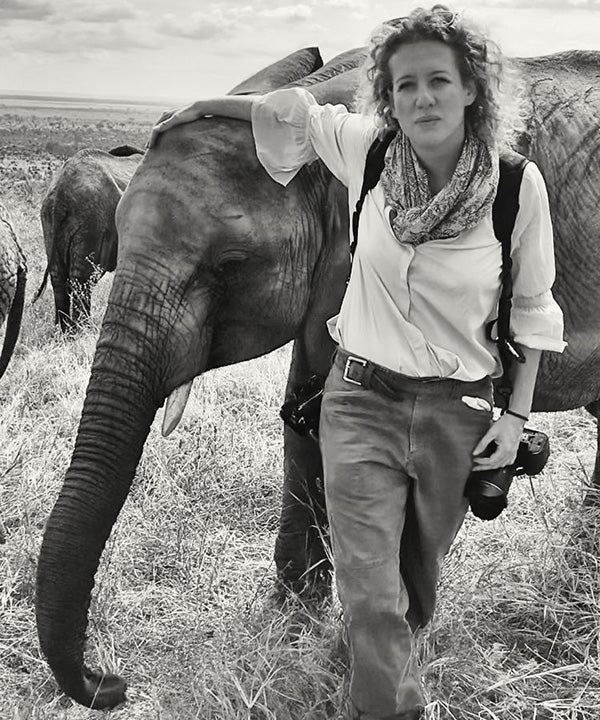
Mia Collis
I read that you grew up in Nairobi and studied anthropology. How did you get into wildlife photography, and how does your degree shape your work?
My grandfather was a photographer and when he died he left me with his lenses and cameras, so I began to photograph in my teens. I read anthropology at University and found it complemented photography very well. I’m a practiced documentary and portrait photographer and more recently conservation photography has become a formative part of my career. An anthropological approach works well when photographing both people and wildlife as empathy and observation are key aspects in making powerful images.
Do you have a favorite animal or place to photograph and why?
To look at, I’d say the Grevy’s Zebra might be one of the most exotic and beautiful species. On an emotional level, elephants are my favorite. They are so intelligent and have complex social structures, which makes them fascinating to be around.
You did a book on elephants and their keepers with our friends at Sheldrick Wildlife Trust. What was the significance of that project for you, and what do you love most about photographing elephants?
The book The Unsung Heroes was such a beautiful collaboration with the Sheldrick Wildlife Trust. I documented stories all over Kenya about ordinary human beings who took courage and did an extraordinary act to save an elephant. It was the most heartwarming project. Recording the lives of the elephants that these humans had saved gave me fascinating insights into elephant behavior. If you can imagine our key emotions, elephants have all these too. They show altruism, complex social structures and family bonds.
Is there a trick to successfully photographing wild Grevy’s zebras? Are they skittish?
Wild Grevy’s Zebra are, more than often, very shy creatures. They have a tendency (like other animals) to turn their back to you, and so periodically I’ll come away with more Grevy’s Zebra bum shots than anything else. The key is a long lens, time on your hands and patience. I was privileged to have a Grevy’s expert from the Grevy’s Zebra Trust on most of my shoots who could guide me to the zebra herds and the right circumstances.
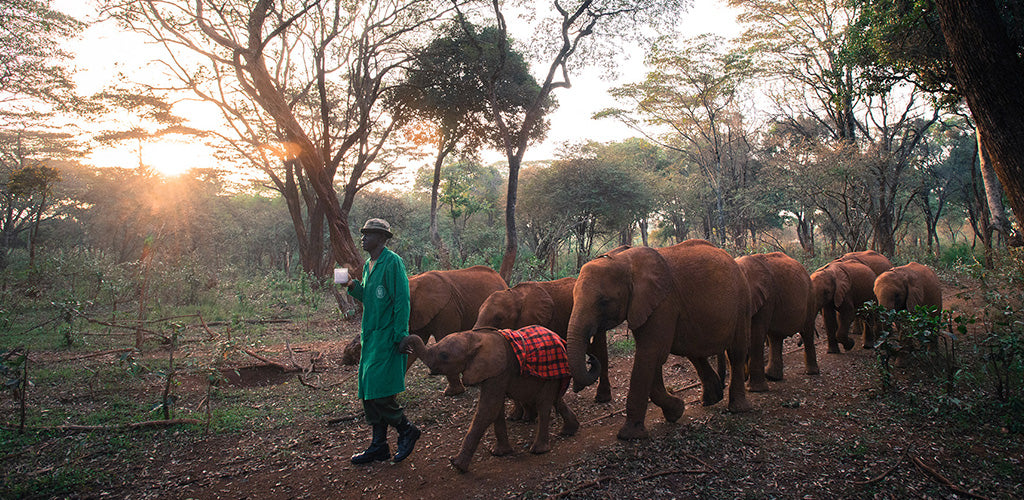
A keeper with baby orphan elephants at Sheldrick Wildlife Trust
What’s the craziest thing that’s happened to you on a shoot?
There have been many. The most recent craziest thing was on assignment photographing an anti-poaching ranger patrol on Mt. Kenya. I walked into a swarm of Safari Ants, an aggressive species that bite really hard. They got well ensconced beneath my clothing and the only way to get rid of them was to strip off. Unfortunately, I was the only female amongst 8 burly male rangers. As I was hopping around, the team leader politely clocked the situation and asked the rangers to face the other way. He politely announced, “we will all look away and you must do what you have to do.” They were extremely gracious and I can only imagine their conversation and giggles around dinner when I’d gone home.
The scariest was a thwarted hippo attack on the banks of the Galana River in Tsavo, Kenya. I was accompanied by an old man who had known the river and the same pod of hippos for 30 years. The old man saved my life by standing unflinching between the hippo and myself for 10 minutes as the hippo charged and then retracted into the water numerous times. I was instructed not to run and to face the hippo. We finally managed to edge slowly backwards enough to run for our lives and reach the vehicle.
"Wild Grevy’s Zebra are, more than often, very shy creatures. The key is a long lens, time on your hands and patience."
Let’s talk about Zebra People—those portraits are so beautiful. What was the impetus for this project and what was your aim with it?
The impetus behind Zebra People was to bring the world’s awareness to a grassroots organization, The Grevy’s Zebra Trust. Their team of people, the “Zebra People”—warriors, elders, ambassadors and scouts—were leading a quiet revolution in animal conservation.
The Zebra People act as guardians and observers of one of the world’s most threatened species, the Grevy’s Zebra. Working with biologists and conservation scientists, they are armed with cameras, checklists, and thousands of years of traditional experience. The team monitor and protect the last 3,000 wild Grevy’s Zebras left on earth. It is a beautiful story that needed telling.
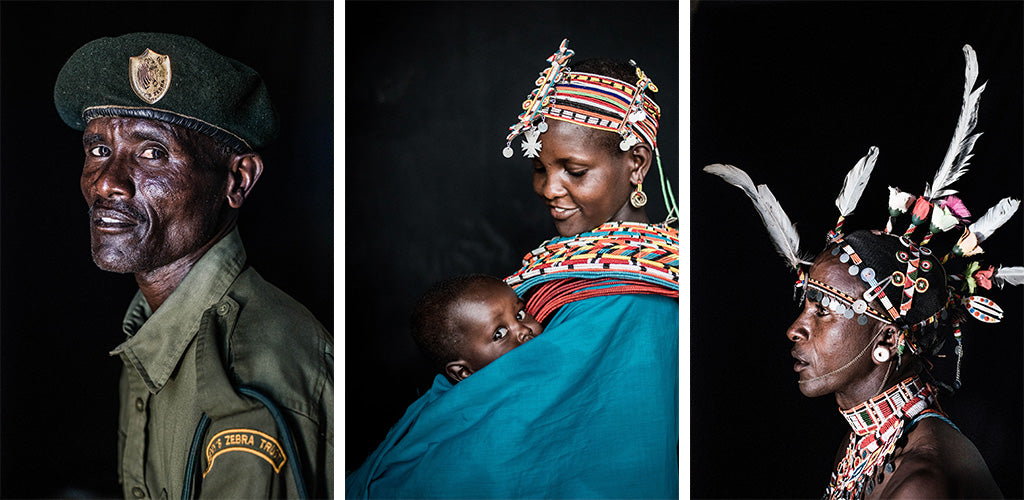
Portraits of “Zebra People” - a Grevy’s Zebra Ambassador, a Scout with her child, and a Warrior.
Can you tell us about how you worked with the Zebra Warriors, Ambassadors, and Scouts to shoot such arresting portraits?
The Grevy’s Zebra Trust field HQ is situated in a remote location in the middle of a vast wilderness in Northern Kenya. To shoot the portraits of the Zebra Warriors, Ambassadors and Scouts, I used the GZT’s storeroom, which was an old shipping container. It made for a great studio. I made use of the natural light by reflecting through the doors of the container onto a black drape that hung behind the subjects. The warriors arrived to be photographed in their traditional dress, which couldn’t have been more spectacular. Traditionally, they present themselves with great pride and so the portraits naturally took on a serious, almost royal tone.
I’ll never forget a day when the cameras turned on me. The Zebra warriors are equipped with cameras to use for their zebra patrols, and during one of our portrait sessions a warrior decided he’d like to make me the subject instead of him. The rest followed suit and suddenly I found myself having to pose for the warriors. It was a real turn of events, being photographed from all angles. Although I’m uncomfortable being photographed in such scrutiny, I made the choice to be as gracious as they had been with me.
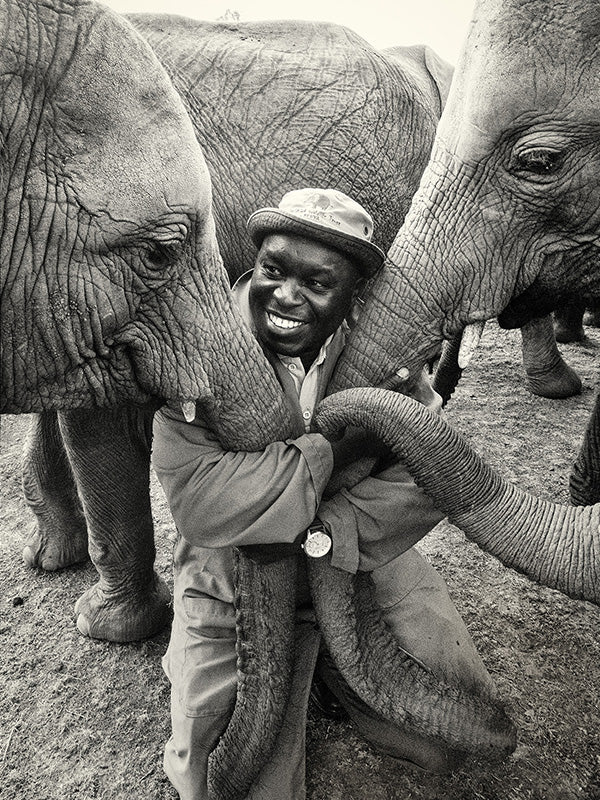
A keeper at Sheldrick Wildlife Trust
What do you hope your audience takes away from these images?
My hope is that the audience recognize what a bold step a small and dedicated group of traditional people are able to take, to protect this critically endangered zebra species. Whether it’s just spreading awareness or purchasing a Chantecaille Zebra Compact, it all becomes a valuable support in conserving the Grevy’s Zebra.
Who or what most inspires you these days?
For people imagery, Mary Ellen Mark’s portraiture is still my all-time favorite. For wildlife, Michael ‘Nick’ Nichols has a truly different and inspiring eye. And over the past few years I’ve spent time with Angela Sheldrick and the Sheldrick Trust elephant keepers whose observations and insights on elephant behavior have been a true eye opener.
Where have you been living during these Covid-restricted times and what are you dreaming of doing next?
My base is Nairobi, Kenya, but I’ve been extremely lucky to have been living most of the time in the bush on assignments. Primarily I’ve been photographing elephants from the Sheldrick Trust, but I’ve also had rewarding work with other conservation organizations. It’s been a busy and reflective time amongst nature here. My next project is putting together a new book from my “Sunday Best at Weekend Studio” project.
Do you have any advice for amateur photographers for how to get good images of wildlife or portraits of people they encounter?
Having patience for both wildlife and people is really important. Often chasing an image or a scenario doesn’t produce the result you want, but if you pause, observe and have that patience, it’s amazing what comes to you. I also believe empathy is really important in this line of work. Empathy always reflects in the image.
Since we’re a beauty brand we have to ask: What’s your daily beauty regimen? And how do you care for your skin when you’re out in some pretty harsh environments for days?
I’ll start my day by applying a natural aloe vera moisturizer over my face and neck, followed by a factor 50 sunscreen—lightly tinted. I then make sure to put a thicker factor 50 sunscreen over my hands, chest and arms. For my eyes, I’ll put a natural earth colored eyeshadow and eyebrow tint followed by a little bronzer and a lip tinted moisturizer. I wear a light cotton scarf around my neck for sun protection, a wide brimmed hat and full sleeved silk, cotton or linen shirts and long pants with leather boots.
Where can people see more of your work if they’re interested?
On Instagram: @mia_collis
On my blog: miacollis.live